

Coal was discovered in Kawakawa in 1861 and the town grew rapidly. In 1875 the church was built to provide for the spiritual needs of the growing Irish Catholic population associated with coal mining. It was originally dedicated as the Church of the Immaculate Conception; it was then called the Church of St Anthony and later given its present name St Francis Xavier Church. By 1884 the population of the town had risen to 1000, 150 of whom were employed in the coalmines. The area at which the church was located was called Irishtown.
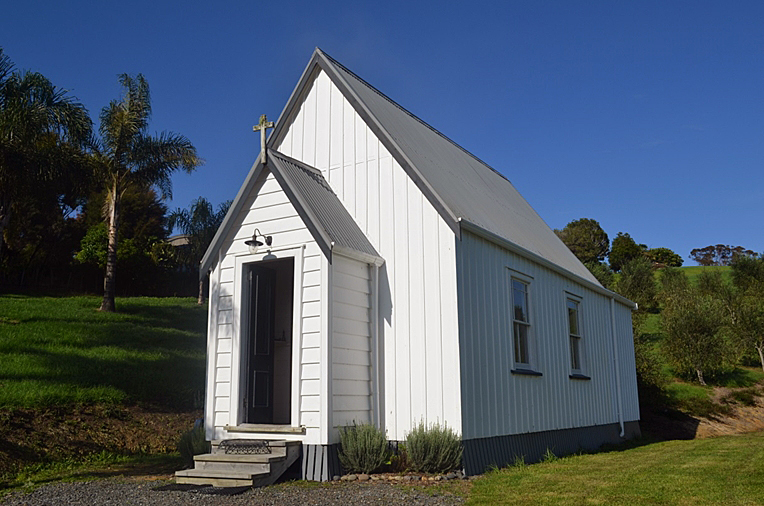
The single storied and high gabled Gothic-style church was built to accommodate up to 100 people and was described as a ‘neat little building’. The building is 14 metres long and 4 metres wide. The external cladding is vertical kauri board and batten and the roof is galvanised iron. The building has a small vestibule at the front and two half doors that open outwards from the vestibule. There are two sash windows on the northern and southern aspect on the building. The interior has vertical match lining on the walls and there is a small elevated pulpit at the eastern end of the church.
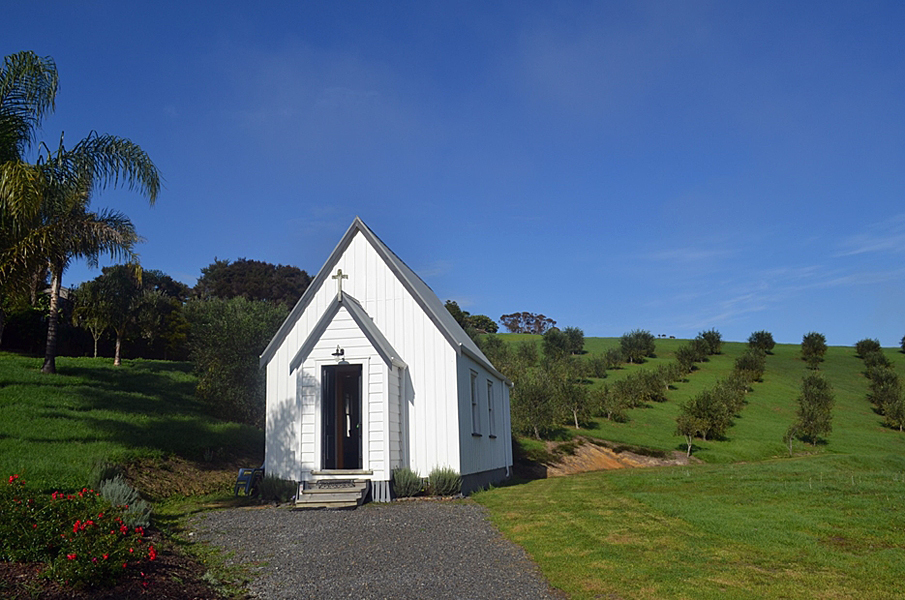
With the closure of the mine and a decline in the Catholic population, the church’s congregation shrank. The last christening was held in the church in 2000 and it was little used after that. The church was removed by new owners to their property at Uruti Bay in 2012. It is now used as a wedding venue known as ‘Russell Chapel on the Olive Grove’. The building has been re-piled, repainted and two small extensions have been added on either side of the building to incorporate a shower and toilet.
List Entry Information
Status
Listed
List Entry Status
Historic Place Category 2
Access
Private/No Public Access
List Number
415
Date Entered
25th November 1982
Date of Effect
15th June 2017
City/District Council
Far North District
Region
Northland Region
Extent of List Entry
Extent includes part of the land described as Lot 13 DP 399498 (RT 396834), North Auckland Land District, and the building known as St Francis Xavier Church (Catholic) (Former) thereon, with a five metre curtilage on all sides. (Refer to map in Appendix 1 of the List entry report for further information).
Legal description
Lot 13 DP 399498 (RT 396834), North Auckland Land District
Status
Listed
List Entry Status
Historic Place Category 2
Access
Private/No Public Access
List Number
415
Date Entered
25th November 1982
Date of Effect
15th June 2017
City/District Council
Far North District
Region
Northland Region
Extent of List Entry
Extent includes part of the land described as Lot 13 DP 399498 (RT 396834), North Auckland Land District, and the building known as St Francis Xavier Church (Catholic) (Former) thereon, with a five metre curtilage on all sides. (Refer to map in Appendix 1 of the List entry report for further information).
Legal description
Lot 13 DP 399498 (RT 396834), North Auckland Land District
Why is this place significant?
Historic Significance
Historic Significance or Value St Francis Xavier Church played an integral role in the Kawakawa community for more than 130 years as a place of worship and venue for religious and social occasions such as christenings, weddings and funerals. It reflects the settlement of this town by mainly Irish Catholic miners in the 1860s-1870s. It has been relocated away from its original historical context, but the relocation itself is representative of the changing nature of religion in New Zealand, and the impact this has had on many historic churches throughout New Zealand. A number of Northland churches in particular have become divested from their original communities as congregations shrink and so does the available pool of capital and labour to maintain these older wooden buildings.
Physical Significance
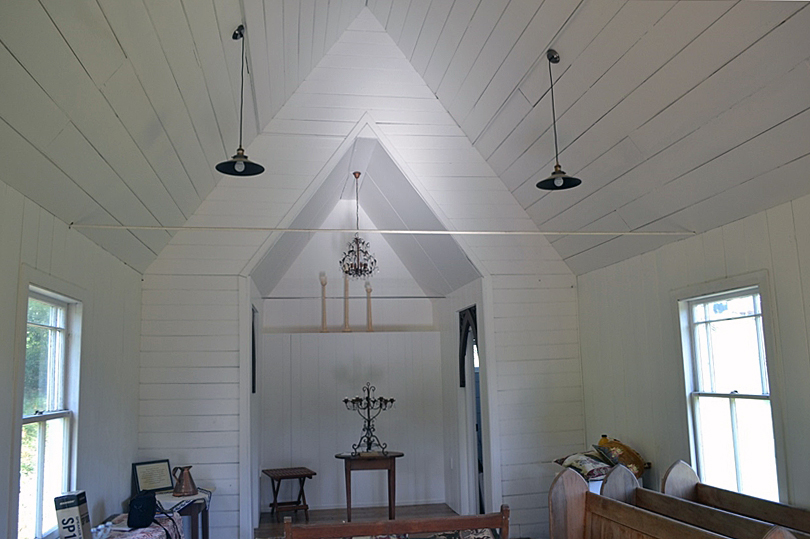
Aesthetic Significance or Value St Francis Xavier Church (Catholic) (Former) is a simple high gabled church building. The simplicity of the structure and the materials used in the building add to its aesthetic values. The building has been painted in white and the native timber floor, which has been left with its original patina, further enhances its aesthetic significance. In its current location, the simple building sits pleasingly in the landscape. Architectural Significance or Value St Francis Xavier Church (Catholic) (Former) has architectural significance as a representative example of a nineteenth century Gothic-style church, typically of modest size, simple design and timber construction. It was first recorded as a ‘neat little structure’ in 1875 and that architectural description still stands. The proportions, simplicity and scale of the building give it human dimensions. There has been some loss of heritage fabric, both externally and internally, but much has survived. The recent additions at the rear of the building have been done sympathetically.
Why is this place Category 1 / Category 2?
Detail Of Assessed Criteria
(a) The extent to which the place reflects important or representative aspects of New Zealand history St Francis Xavier Church (Catholic) (Former) reflect the European settlement of Northland in the mid to late nineteenth century due to industries such as coal mining, gum digging and timber milling, and the importance of religion to these early settlers. In particular it reflects the immigration and settlement of Irish Catholics in Kawakawa, to work in the coal mining industry. St Francis Xavier Church (Catholic) (Former) also reflects the changing nature of religion in New Zealand, and the impact this has had on many historic churches, particularly in smaller towns and rural areas. In this case, the former church was saved through relocation and reuse as a wedding and events venue.
Why is this place significant?
Historic Significance
Historic Significance or Value St Francis Xavier Church played an integral role in the Kawakawa community for more than 130 years as a place of worship and venue for religious and social occasions such as christenings, weddings and funerals. It reflects the settlement of this town by mainly Irish Catholic miners in the 1860s-1870s. It has been relocated away from its original historical context, but the relocation itself is representative of the changing nature of religion in New Zealand, and the impact this has had on many historic churches throughout New Zealand. A number of Northland churches in particular have become divested from their original communities as congregations shrink and so does the available pool of capital and labour to maintain these older wooden buildings.
Physical Significance
Aesthetic Significance or Value St Francis Xavier Church (Catholic) (Former) is a simple high gabled church building. The simplicity of the structure and the materials used in the building add to its aesthetic values. The building has been painted in white and the native timber floor, which has been left with its original patina, further enhances its aesthetic significance. In its current location, the simple building sits pleasingly in the landscape. Architectural Significance or Value St Francis Xavier Church (Catholic) (Former) has architectural significance as a representative example of a nineteenth century Gothic-style church, typically of modest size, simple design and timber construction. It was first recorded as a ‘neat little structure’ in 1875 and that architectural description still stands. The proportions, simplicity and scale of the building give it human dimensions. There has been some loss of heritage fabric, both externally and internally, but much has survived. The recent additions at the rear of the building have been done sympathetically.
Why is this place Category 1 / Category 2?
Detail Of Assessed Criteria
(a) The extent to which the place reflects important or representative aspects of New Zealand history St Francis Xavier Church (Catholic) (Former) reflect the European settlement of Northland in the mid to late nineteenth century due to industries such as coal mining, gum digging and timber milling, and the importance of religion to these early settlers. In particular it reflects the immigration and settlement of Irish Catholics in Kawakawa, to work in the coal mining industry. St Francis Xavier Church (Catholic) (Former) also reflects the changing nature of religion in New Zealand, and the impact this has had on many historic churches, particularly in smaller towns and rural areas. In this case, the former church was saved through relocation and reuse as a wedding and events venue.
Construction Professional
Name
Moore, J
Type
Builder
Biography
In 1880 Mr J Moore was advertising in the Kawakawa Luminary as a bricklayer, repairer of stoves, chimneys and a contractor. He was active in community affairs and served on the Kawakawa school committee in 1894. Source: List Entry Review Report for St Francis Xavier Church (Catholic) (Former), List No. 415, 15 May 2017
Construction Details
Start Year
1875
Type
Original Construction
Start Year
2012
Finish Year
2012
Type
Relocation
Description
Relocation from Kawakawa to Uruti Bay, Russell and addition of two small rooms at the rear of the building. The building was also reroofed and repainted soon after its relocation.
Construction Materials
Timber, stained glass, corrugated iron
Construction Professional
Name
Moore, J
Type
Builder
Biography
In 1880 Mr J Moore was advertising in the Kawakawa Luminary as a bricklayer, repairer of stoves, chimneys and a contractor. He was active in community affairs and served on the Kawakawa school committee in 1894. Source: List Entry Review Report for St Francis Xavier Church (Catholic) (Former), List No. 415, 15 May 2017
Construction Details
Start Year
1875
Type
Original Construction
Start Year
2012
Finish Year
2012
Type
Relocation
Description
Relocation from Kawakawa to Uruti Bay, Russell and addition of two small rooms at the rear of the building. The building was also reroofed and repainted soon after its relocation.
Construction Materials
Timber, stained glass, corrugated iron
Early history of Kawakawa Kawakawa is situated in the rohe of Ngāti Hine. The rohe of Ngāti Hine is composed of hilly terrain, fertile valleys and large tracts of swampland. The main river is Te Awa Tapu o Taumerere and numerous creeks and swamps criss-cross the landscape. Into this landscape of swamp and hills settled the descendants of Hineāmaru, the ancestor of Ngāti Hine iwi. Kawakawa is at confluence of the Waiōmio and Waiharakeke streams. There are many archaeological sites situated downstream of Kawakawa that are associated with Māori settlement of the area; these include pā, gardens, terraces and middens. Establishment of ‘Irishtown’ In 1859 Maihi Paraone Kawiti (son of Ngā Puhi rangatira Te Ruki Kawiti) had asked the Governor (Gore Brown) to have the Kawakawa area settled by Pākehā and a town established. The Governor replied that he was pleased that Māori had agreed to sell the land around Kawakawa but favoured Kerikeri as the site of a town in the Bay of Islands. However this decision was changed when coal was discovered in Kawakawa in 1861. When the specimens of coal were sent to Auckland for tests it revealed that the coal was of the best quality and excellent for both steam and gas making. The District Land Commissioner Henry Tracey Kemp negotiated the purchase of 24,000 acres of land around Kawakawa from its Māori owners. The town of Kawakawa was built around coal and the first railway in the North Island was constructed in 1868 to carry coal to the nearby Taumarere Wharf and Landing on the Kawakawa River. The town grew rapidly and by 1884 the population was 1000, 150 of whom were employed in the coalmines. Because of the large number of Irish settlers, Kawakawa was called Irishtown. The town was described as the Newcastle of the Southern Seas and was a bustling mining centre. In 1899 Kawakawa suffered from a fire and a large part of the town was burned down. The coal had a very good reputation but the problem was that the mines were subject to flooding which meant that they eventually closed in the 1920s. A combination of fire and mine closure meant that the mining families who were mainly Irish Catholics for the most part moved away from Kawakawa. The town continued as a service town for agriculture and forestry. Construction of the Church To support the spiritual needs of its Catholic community (mainly Irish Catholic miners), funds were raised and a church was built and consecrated in December 1875, at 25 North Road. It was originally dedicated as the Church of the Immaculate Conception; it was then called the Church of St Anthony and later given its present name St Francis Xavier Church. It was the first Catholic Church in Kawakawa. It was recorded as a ‘neat little structure’ capable of accommodating about 100 persons and built by the contractor Mr J. Moore. The church was opened by the Rev. Father McDonald on Wednesday 8 December 1875, on the feast of the Immaculate Conception when mass was celebrated in it for the first time. The Daily Southern Cross reports that the church was ‘crowded, both then and in the evening, when there were devotions followed by Benediction of the Blessed Sacrament’. Rev. Macdonald had ‘selected the beautiful site’ where the church stood and Rev. J.B. Simpson helped fundraise for its erection. The church had a regular pastoral tour by James Mahoney soon after opening and appears to have been very well attended in its early years, with a report in April 1880 that Easter Sunday services were held ‘in the little Catholic church where large numbers embraced the opportunity to attend Mass’. In addition to worship, the church was used for christenings, weddings and funerals and was an integral part of the Kawakawa community. A Dwindling Congregation Mining finished in the 1920s and the population of Kawakawa has continued to decline, particularly from the 1980s. The last christening was held in the church in 2000. In 2001, written correspondence from the Chair of the Kawakawa Community Board to the then New Zealand Historic Places Trust noted that there had been inappropriate additions to the church as well as replacement of heritage fabric, both externally and internally. The letter also pointed out that the building did not suit the needs of the community due to its current condition, size and location. In 2005 the church was one of the oldest churches in Northland still in use. The congregation continued to dwindle however, with the Catholic population in Kawakawa dropping from 10.2% in 2006 to 6.6% in 2013. The church fell into disrepair and was sold by the Catholic Church in 2012 to private owners. Relocation and Reuse The new owners relocated the church building to their property at Uruti Bay. It was transported by truck to Opua then crossed the Opua Inlet by car ferry in December 2012. The roof was removed and transported separately so that the chapel could pass safely under power lines on its journey to the Opua carry ferry. Following relocation, the church was repainted, reroofed and two small extensions were added on either side of the rear of the building to incorporate a shower and toilet. The church was deconsecrated by Father Damian from Okaihau and is now used as a wedding and events venue known as ‘Russell Chapel on the Olive Grove’.
Early history of Kawakawa Kawakawa is situated in the rohe of Ngāti Hine. The rohe of Ngāti Hine is composed of hilly terrain, fertile valleys and large tracts of swampland. The main river is Te Awa Tapu o Taumerere and numerous creeks and swamps criss-cross the landscape. Into this landscape of swamp and hills settled the descendants of Hineāmaru, the ancestor of Ngāti Hine iwi. Kawakawa is at confluence of the Waiōmio and Waiharakeke streams. There are many archaeological sites situated downstream of Kawakawa that are associated with Māori settlement of the area; these include pā, gardens, terraces and middens. Establishment of ‘Irishtown’ In 1859 Maihi Paraone Kawiti (son of Ngā Puhi rangatira Te Ruki Kawiti) had asked the Governor (Gore Brown) to have the Kawakawa area settled by Pākehā and a town established. The Governor replied that he was pleased that Māori had agreed to sell the land around Kawakawa but favoured Kerikeri as the site of a town in the Bay of Islands. However this decision was changed when coal was discovered in Kawakawa in 1861. When the specimens of coal were sent to Auckland for tests it revealed that the coal was of the best quality and excellent for both steam and gas making. The District Land Commissioner Henry Tracey Kemp negotiated the purchase of 24,000 acres of land around Kawakawa from its Māori owners. The town of Kawakawa was built around coal and the first railway in the North Island was constructed in 1868 to carry coal to the nearby Taumarere Wharf and Landing on the Kawakawa River. The town grew rapidly and by 1884 the population was 1000, 150 of whom were employed in the coalmines. Because of the large number of Irish settlers, Kawakawa was called Irishtown. The town was described as the Newcastle of the Southern Seas and was a bustling mining centre. In 1899 Kawakawa suffered from a fire and a large part of the town was burned down. The coal had a very good reputation but the problem was that the mines were subject to flooding which meant that they eventually closed in the 1920s. A combination of fire and mine closure meant that the mining families who were mainly Irish Catholics for the most part moved away from Kawakawa. The town continued as a service town for agriculture and forestry. Construction of the Church To support the spiritual needs of its Catholic community (mainly Irish Catholic miners), funds were raised and a church was built and consecrated in December 1875, at 25 North Road. It was originally dedicated as the Church of the Immaculate Conception; it was then called the Church of St Anthony and later given its present name St Francis Xavier Church. It was the first Catholic Church in Kawakawa. It was recorded as a ‘neat little structure’ capable of accommodating about 100 persons and built by the contractor Mr J. Moore. The church was opened by the Rev. Father McDonald on Wednesday 8 December 1875, on the feast of the Immaculate Conception when mass was celebrated in it for the first time. The Daily Southern Cross reports that the church was ‘crowded, both then and in the evening, when there were devotions followed by Benediction of the Blessed Sacrament’. Rev. Macdonald had ‘selected the beautiful site’ where the church stood and Rev. J.B. Simpson helped fundraise for its erection. The church had a regular pastoral tour by James Mahoney soon after opening and appears to have been very well attended in its early years, with a report in April 1880 that Easter Sunday services were held ‘in the little Catholic church where large numbers embraced the opportunity to attend Mass’. In addition to worship, the church was used for christenings, weddings and funerals and was an integral part of the Kawakawa community. A Dwindling Congregation Mining finished in the 1920s and the population of Kawakawa has continued to decline, particularly from the 1980s. The last christening was held in the church in 2000. In 2001, written correspondence from the Chair of the Kawakawa Community Board to the then New Zealand Historic Places Trust noted that there had been inappropriate additions to the church as well as replacement of heritage fabric, both externally and internally. The letter also pointed out that the building did not suit the needs of the community due to its current condition, size and location. In 2005 the church was one of the oldest churches in Northland still in use. The congregation continued to dwindle however, with the Catholic population in Kawakawa dropping from 10.2% in 2006 to 6.6% in 2013. The church fell into disrepair and was sold by the Catholic Church in 2012 to private owners. Relocation and Reuse The new owners relocated the church building to their property at Uruti Bay. It was transported by truck to Opua then crossed the Opua Inlet by car ferry in December 2012. The roof was removed and transported separately so that the chapel could pass safely under power lines on its journey to the Opua carry ferry. Following relocation, the church was repainted, reroofed and two small extensions were added on either side of the rear of the building to incorporate a shower and toilet. The church was deconsecrated by Father Damian from Okaihau and is now used as a wedding and events venue known as ‘Russell Chapel on the Olive Grove’.
Current Description The former church is located within an olive grove setting to the north-west of Russell Whakapara Road, elevated above Uruti Bay. It is a single storied high gabled Gothic-style building. The dimensions of the building are 14m in length and 4m in width. The external cladding is vertical board and batten: 250mm wide board with 50mm wide battens. The roof is galvanised iron and the joinery is wooden. The building has a small vestibule at the front with a cross on top, and two half doors that open outwards from the vestibule. There are two sash windows on the northern and southern sides on the building. The rear of building (the western end) has had two small additions (2012) on either side for a toilet and shower. In each of the additions a small casement window has been inserted which is stained glass for privacy. These replace earlier additions that had been added to the building when it was in its former location at Kawakawa and that were larger and clad with fibrolite. The new additions have been clad in weatherboards and are a more sympathetic addition than the earlier additions. Internally the church has vertical match -lining on the walls and the match lining is 200mm wide. The floor boards are 300mm wide and run along the building as does the match- lining used for the ceiling. At the western end of the church is a small elevated pulpit and to delineate the area, the floor boards and match lining run across the building. Most of the timber used in the building is native, for the most part kauri. Both the exterior and interior of the church are currently painted white.
Current Description The former church is located within an olive grove setting to the north-west of Russell Whakapara Road, elevated above Uruti Bay. It is a single storied high gabled Gothic-style building. The dimensions of the building are 14m in length and 4m in width. The external cladding is vertical board and batten: 250mm wide board with 50mm wide battens. The roof is galvanised iron and the joinery is wooden. The building has a small vestibule at the front with a cross on top, and two half doors that open outwards from the vestibule. There are two sash windows on the northern and southern sides on the building. The rear of building (the western end) has had two small additions (2012) on either side for a toilet and shower. In each of the additions a small casement window has been inserted which is stained glass for privacy. These replace earlier additions that had been added to the building when it was in its former location at Kawakawa and that were larger and clad with fibrolite. The new additions have been clad in weatherboards and are a more sympathetic addition than the earlier additions. Internally the church has vertical match -lining on the walls and the match lining is 200mm wide. The floor boards are 300mm wide and run along the building as does the match- lining used for the ceiling. At the western end of the church is a small elevated pulpit and to delineate the area, the floor boards and match lining run across the building. Most of the timber used in the building is native, for the most part kauri. Both the exterior and interior of the church are currently painted white.
Historical and Associated Iwi / Hapū / Whānau
Completion Date
15th May 2017
Report Written By
Bill Edwards
Information Sources
Boese, 1977
Kay Boese, 'Tides of History: Bay of Islands County', Whangarei, 1977
Lee, 1983
Lee, J., The Bay of Islands. Reed Publications, Auckland, 1983
Middleton, 2014
Middleton, A., Pewhairangi Bay of Islands Missions and Maori 1814 to 1845, Otago University Press, Dunedin, 2014.
Other Information
A fully referenced New Zealand Heritage List report is available on request from the Northland Area Office of Heritage New Zealand. Please note that entry on the New Zealand Heritage List/Rarangi Korero identifies only the heritage values of the property concerned, and should not be construed as advice on the state of the property, or as a comment of its soundness or safety, including in regard to earthquake risk, safety in the event of fire, or insanitary conditions.
Historical and Associated Iwi / Hapū / Whānau
Completion Date
15th May 2017
Report Written By
Bill Edwards
Information Sources
Boese, 1977
Kay Boese, 'Tides of History: Bay of Islands County', Whangarei, 1977
Lee, 1983
Lee, J., The Bay of Islands. Reed Publications, Auckland, 1983
Middleton, 2014
Middleton, A., Pewhairangi Bay of Islands Missions and Maori 1814 to 1845, Otago University Press, Dunedin, 2014.
Other Information
A fully referenced New Zealand Heritage List report is available on request from the Northland Area Office of Heritage New Zealand. Please note that entry on the New Zealand Heritage List/Rarangi Korero identifies only the heritage values of the property concerned, and should not be construed as advice on the state of the property, or as a comment of its soundness or safety, including in regard to earthquake risk, safety in the event of fire, or insanitary conditions.
Current Usages
Uses: Civic Facilities
Specific Usage: Wedding Venue
Former Usages
General Usage: Religion
Specific Usage: Church
Web Links
description: Russell Chapel on the Olive Grove website
Current Usages
Uses: Civic Facilities
Specific Usage: Wedding Venue
Former Usages
General Usage: Religion
Specific Usage: Church
Web Links
description: Russell Chapel on the Olive Grove website
Location
Stay up to date with Heritage this month
